
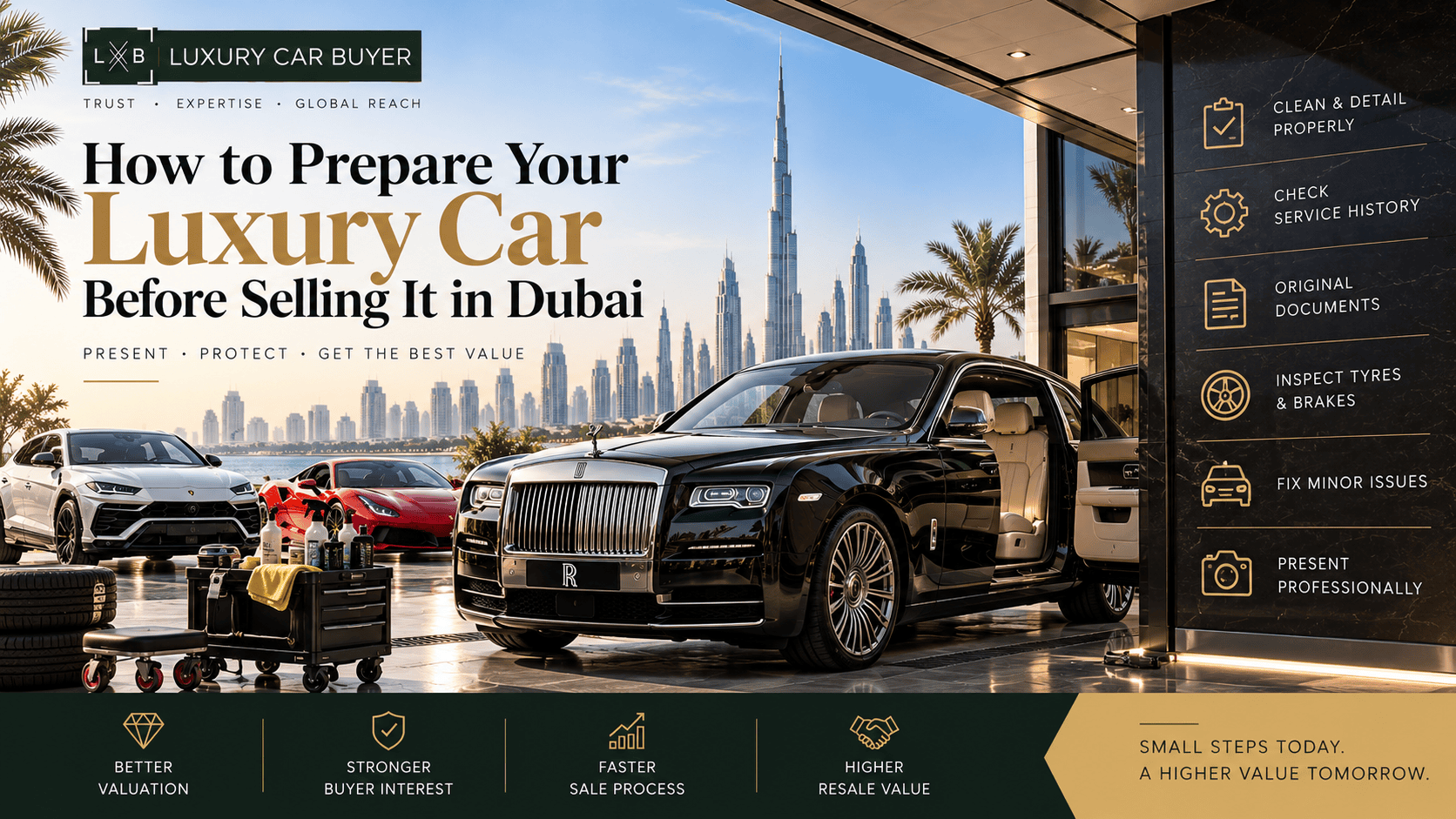
Selling a luxury car in Dubai requires more than simply placing an advertisement and waiting for buyers to respond. Premium vehicles are often assessed closely for their condition, specification, service history, mileage, provenance and overall presentation.
Before you sell, taking the time to prepare your car properly can make the selling process more organised and help potential buyers understand the vehicle’s true condition.
Whether you own a Ferrari, Lamborghini, Porsche, Rolls-Royce, Bentley, Aston Martin, McLaren, Maserati, Range Rover or another premium vehicle, the preparation process should begin before the car is presented for valuation or inspection.
This guide explains how to prepare your luxury car for sale in Dubai, from documentation and maintenance to detailing, inspection and final presentation.
Why Preparing Your Luxury Car Before Selling Matters
Luxury-car buyers generally expect a higher level of presentation and transparency than they might expect from an ordinary used vehicle.
A poorly presented car can raise unnecessary questions about how it has been maintained. On the other hand, a clean vehicle with organised records and clearly explained history gives buyers a better understanding of what they are considering.
Preparation does not mean spending heavily on the vehicle.
The objective is to:
- Present the car in its best genuine condition
- Organise important documentation
- Identify obvious mechanical or cosmetic issues
- Make service history easy to understand
- Be transparent about the vehicle’s history
- Make the inspection process easier
- Give a prospective buyer confidence in the vehicle
The right preparation can also help you avoid last-minute surprises during valuation or inspection.
Start With Your Luxury Car’s Documentation
Before arranging a valuation or speaking to potential buyers, collect all available documents relating to the vehicle.
For a luxury car, documentation can be particularly valuable because it helps establish the vehicle’s ownership and maintenance history.
Depending on the vehicle, useful records can include:
- Vehicle registration documents
- Service records
- Maintenance invoices
- Major repair invoices
- Warranty documents
- Inspection reports
- Previous ownership information
- Import documentation, where applicable
- Spare key information
- Finance-related documents, if applicable
Keep the records together rather than searching for individual documents every time a buyer asks a question.
A well-organised history makes it easier to explain the vehicle and can make the overall selling process more efficient.
Organise Your Service History
Service history is one of the most important areas to prepare before selling a luxury vehicle.
A potential buyer may want to understand how regularly the car has been maintained, where it was serviced and whether major maintenance has been completed.
Gather:
- Service books
- Dealer or authorised-service records
- Specialist workshop invoices
- Oil-service records
- Brake replacement invoices
- Tyre replacement records
- Battery replacement records
- Major mechanical repair invoices
- Warranty records
If the vehicle has been maintained by a specialist independent workshop rather than an authorised dealer, keep those invoices as well.
Do not assume that only authorised-dealer records are useful. Clear documentation from a reputable specialist can still provide valuable information about the vehicle’s maintenance.
Check the Vehicle’s Current Mechanical Condition
Before presenting the vehicle to a buyer, pay attention to obvious mechanical problems.
You do not necessarily need to rebuild or refurbish the car before selling it. However, issues that are clearly visible or noticeable during a test drive should not be ignored.
Check for:
- Dashboard warning lights
- Unusual engine noises
- Transmission issues
- Fluid leaks
- Brake vibration or unusual brake noise
- Uneven tyre wear
- Weak air conditioning
- Suspension noises
- Electrical problems
- Malfunctioning cameras or sensors
- Faulty windows or electronic controls
For a luxury vehicle, small issues can attract disproportionate attention because buyers know that repairs on sophisticated vehicles can be expensive.
The best approach is to identify the condition of the vehicle honestly before the valuation process.
Should You Service the Car Before Selling?
This depends on the vehicle’s condition and how close it is to its scheduled maintenance.
If a service is already due, completing the required maintenance may make sense. If the car has recently been serviced and is running correctly, another unnecessary service may not provide the same benefit.
Before spending a significant amount of money, consider:
- What work is actually required?
- Is the work safety-related?
- Is the service already due?
- Will the repair materially improve the vehicle?
- Is there documentation for the work?
- Is the cost justified by the expected benefit?
Avoid carrying out expensive upgrades simply because you assume they will be recovered in the selling price.
A professional valuation can help you understand the vehicle’s current position before deciding how much additional work to undertake.
Inspect the Tyres and Brakes
Tyres and brakes are among the areas buyers can notice quickly during an inspection or test drive.
Check:
- Tyre tread
- Tyre age
- Uneven tyre wear
- Cracks or visible damage
- Brake-pad condition
- Brake-disc condition
- Unusual vibration or noise
For high-performance and exotic cars, tyre and brake specifications can be particularly important.
If the vehicle uses specialised tyres, carbon-ceramic brakes or other performance components, retain invoices and documentation for recent replacements where available.
Check the Air Conditioning
Air conditioning deserves particular attention when preparing a luxury car for sale in Dubai.
A vehicle may look excellent externally but immediately create a negative impression if the air conditioning does not perform properly.
Before showing the car, check that:
- The system cools properly
- All climate-control functions work
- Front and rear climate controls operate where fitted
- Seat ventilation or heating works where fitted
- No unusual smells come from the vents
Do not simply mask an unpleasant odour with an air freshener.
If there is an underlying problem, identify and address the cause where appropriate.
Give the Interior a Professional-Level Clean
The interior is one of the first areas a potential buyer experiences directly.
Luxury vehicles often use premium leather, Alcantara, carbon fibre, wood, metal trim and other specialised materials. These materials should be cleaned using products appropriate for the particular finish.
Pay attention to:
- Seats
- Carpets
- Floor mats
- Dashboard
- Centre console
- Door panels
- Air vents
- Steering wheel
- Switches
- Screens
- Cup holders
- Boot area
Remove personal belongings from the vehicle.
A clean, uncluttered interior allows the buyer to focus on the vehicle rather than the previous owner’s belongings.
Avoid excessive use of glossy dressing products or strong fragrances. A luxury interior should look clean and well maintained rather than heavily treated.
Clean and Detail the Exterior
Exterior presentation is particularly important when selling a premium vehicle.
Start with a thorough wash and clean the:
- Paintwork
- Wheels
- Tyres
- Glass
- Grilles
- Headlights
- Taillights
- Door jambs
- Exhaust outlets
If the paint has minor swirl marks or contamination, professional detailing may improve its presentation.
However, expensive paint correction or ceramic coating is not automatically necessary before every sale.
Consider the vehicle’s current condition and the likely benefit before spending significant money.
The objective is to present the car honestly and professionally, not to disguise its condition.
Pay Attention to the Wheels and Tyres
Luxury and performance cars often have large, distinctive wheels that can strongly influence the vehicle’s appearance.
Check for:
- Kerb damage
- Scratches
- Paint deterioration
- Cracks
- Uneven tyre wear
- Incorrect tyre pressures
- Mismatched tyres
If the wheels have been refurbished, keep any available invoices or documentation.
If the vehicle has its original wheels and accessories stored separately, make sure they are available if they are part of the sale.
Check All Electronic Features
Modern luxury vehicles can contain a large number of electronic features.
Before selling, test the features you know are fitted to the vehicle.
These may include:
- Infotainment system
- Navigation
- Bluetooth
- Apple CarPlay or Android Auto
- Cameras
- Parking sensors
- Driver-assistance systems
- Electric seats
- Seat memory
- Climate controls
- Sunroof
- Electric boot
- Keyless entry
- Ambient lighting
- Premium audio system
A buyer may check these features during an inspection, so identifying problems in advance gives you time to decide how to handle them.
Keep All Original Keys and Accessories
If you received two keys when you purchased the vehicle, keep both available.
The same applies to original accessories and equipment such as:
- Key fobs
- Owner’s manuals
- Service books
- Charging cables
- Tool kits
- Spare wheel where fitted
- Original floor mats
- Vehicle covers
- Manufacturer accessories
For certain luxury and exotic vehicles, original equipment and accessories can contribute to the overall desirability of the car.
Be Clear About Accident and Repair History
One of the most important principles when preparing a luxury car for sale is transparency.
If the vehicle has previously been involved in an accident or received significant body repairs, do not attempt to hide that information.
Instead, gather whatever documentation is available.
Useful records may include:
- Insurance repair documents
- Workshop invoices
- Photos from before or during repair
- Parts invoices
- Inspection reports
A buyer may discover repair history during verification or inspection anyway.
Being transparent from the beginning can make the transaction more straightforward and allows the vehicle to be assessed based on its actual history and condition.
Verify the Vehicle’s GCC or Imported Specification
Before selling, know whether your vehicle is GCC specification or imported from another market.
For imported vehicles, collect available information about:
- Country of origin
- Previous registration
- Import history
- Service records
- Accident history
- Previous ownership
- Customs or import documentation where available
GCC specification can be an important consideration in the Dubai market, but it should not be treated as the only factor determining value.
The vehicle’s condition, history, specification, mileage and current market demand all need to be considered.
Check the Mileage and Vehicle History
Make sure the mileage displayed on the vehicle corresponds with your available records.
Service invoices can help establish a consistent maintenance timeline.
If there are discrepancies or gaps in the history, identify them before presenting the vehicle to a buyer.
Do not alter, conceal or misrepresent mileage.
Luxury-car buyers are often particularly interested in provenance and documentation, especially when considering high-value or collectible vehicles.
Consider a Pre-Sale Vehicle Inspection
A pre-sale inspection can be useful when you want to understand the vehicle’s current condition before negotiating with buyers.
An inspection may identify issues involving:
- Engine
- Transmission
- Suspension
- Brakes
- Tyres
- Electronics
- Air conditioning
- Bodywork
- Interior
- Diagnostic systems
The value of an inspection is not simply finding faults.
It can also help establish what is working correctly and give you a clearer understanding of the vehicle before discussions begin.
For a high-value luxury vehicle, having a clear picture of its condition can make the selling process more structured.
Do Not Spend More on Repairs Than the Car Can Justify
One of the most common mistakes sellers can make is assuming every repair will be returned in the final selling price.
That is not always the case.
For example, spending a large amount on cosmetic work does not necessarily mean the vehicle’s market value will increase by the same amount.
Before approving expensive work, consider:
- The vehicle’s current market value
- The cost of the repair
- Whether the issue affects safety or usability
- Whether the repair improves buyer confidence
- Whether the work is documented
- Whether the repair is important to the vehicle’s specific market
A professional valuation can help you decide which preparation steps are worthwhile.
Prepare High-Quality Photos
If you are selling privately or presenting the vehicle online, photographs are extremely important.
Take photographs after the vehicle has been cleaned.
Useful photographs include:
- Front three-quarter view
- Rear three-quarter view
- Full side views
- Front and rear
- Wheels
- Interior
- Dashboard
- Instrument cluster
- Odometer
- Centre console
- Seats
- Boot
- Engine bay
- Important options
Do not heavily edit photographs or hide imperfections.
Luxury-car buyers usually want a clear understanding of the vehicle before arranging a viewing.
Honest photographs can help attract more relevant enquiries.
Prepare a Clear Vehicle Specification
Before speaking with buyers, prepare a concise summary of your vehicle.
Include:
- Make
- Model
- Model year
- Variant
- Mileage
- Exterior colour
- Interior colour
- GCC or imported specification
- Service history
- Number of keys
- Major options
- Recent maintenance
- Accident history
- Warranty status where applicable
This information makes it easier to communicate the vehicle accurately and can speed up the initial valuation process.
Remove Personal Items and Accessories You Are Keeping
Before showing the vehicle, remove anything that is not included in the sale.
Check:
- Glovebox
- Centre console
- Door pockets
- Boot
- Under seats
- Storage compartments
If you are keeping a personal accessory, remove it before photographing or showing the car so there is no misunderstanding about what is included.
Make a Final Walk-Around Before the Valuation
Before arranging the valuation, take a final walk around the vehicle.
Look at the car as if you were seeing it for the first time.
Check:
Exterior
- Paint
- Wheels
- Tyres
- Lights
- Glass
- Body panels
- Badges
- Exhaust
Interior
- Seats
- Carpets
- Dashboard
- Screens
- Controls
- Air conditioning
- Trim
Mechanical
- Warning lights
- Fluid leaks
- Unusual noises
- Brakes
- Tyres
- Battery
Documentation
- Registration documents
- Service records
- Repair invoices
- Warranty records
- Keys
- Accessories
This final review can help you identify small issues before the buyer or inspector does.
What You Should Not Do Before Selling Your Luxury Car
Preparation is important, but there are also things you should avoid.
Do Not Hide Defects
Trying to conceal a mechanical, cosmetic or accident-related issue can create bigger problems later.
Do Not Alter the Mileage
Mileage should always be represented accurately.
Do Not Make Unnecessary Expensive Repairs
Not every repair produces an equivalent increase in market value.
Do Not Use Heavy Cosmetic Treatments to Hide Problems
Presentation should improve the vehicle’s appearance, not conceal its actual condition.
Do Not Remove Important Records
Keep service records, invoices and other documentation available.
Do Not Overstate the Vehicle’s Specification
Describe factory options and modifications accurately.
Luxury Car Preparation Checklist
Before selling your luxury car in Dubai, use this checklist:
-
Gather vehicle documents
-
Organise service history
-
Collect repair and maintenance invoices
-
Check mileage records
-
Confirm GCC or imported specification
-
Check warning lights
-
Inspect tyres
-
Check brakes
-
Test air conditioning
-
Check electrical features
-
Clean the interior
-
Detail the exterior
-
Clean wheels and tyres
-
Keep all original keys
-
Gather original accessories
-
Document accident or repair history
-
Consider a pre-sale inspection
-
Take clear photographs
-
Prepare an accurate vehicle specification
-
Remove personal belongings
-
Arrange a professional valuation
When Is the Right Time to Get a Luxury Car Valuation?
Ideally, obtain a valuation after you have gathered the vehicle’s basic information and documentation but before committing to major repairs or expensive cosmetic work.
This allows you to understand the vehicle’s current market position first.
You can then decide whether additional preparation is worthwhile based on the vehicle, its condition and your selling objectives.
For more information about timing, see our guide to the best time to sell a luxury car in Dubai.
Sell Your Prepared Luxury Car in Dubai
Once your luxury car has been prepared, the next step is understanding its current market value and choosing the right way to sell it.
UAE Luxury Car Buyer works as an independent luxury car sourcing and buying agent in Dubai, helping owners with vehicle assessment, verification, inspection, negotiation and purchasing.
The company works with premium, exotic, hypercar and rare vehicles and can also assist with international export requirements where applicable.
You do not need to prepare the vehicle to an unrealistic standard or spend heavily on unnecessary work. The goal is to present the car honestly, provide the relevant documentation and understand its actual market position.
If you are ready to sell your luxury car, you can request a professional assessment through our luxury car buying service.
Sell Your Luxury Car in Dubai:
https://uaeluxurycarbuyer.com/sell-luxury-car-in-dubai/
Frequently Asked Questions
Should I service my luxury car before selling it in Dubai?
If the vehicle is due for scheduled maintenance or has an obvious mechanical issue, servicing or repairing it may be worth considering. However, expensive work should be evaluated against the vehicle’s expected market value before spending money.
Should I detail my luxury car before selling it?
Professional cleaning and detailing can improve the vehicle’s presentation and make it easier for buyers to assess. The level of detailing should be appropriate for the vehicle’s condition and value.
Does cleaning increase the value of a luxury car?
Cleanliness can improve presentation and buyer confidence, but it does not automatically add a fixed amount to the vehicle’s market value. Condition, specification, mileage, history and demand remain important valuation factors.
Should I get my luxury car inspected before selling?
A pre-sale inspection can help identify mechanical, electrical and cosmetic issues before negotiations begin. It can also give the seller a clearer understanding of the vehicle’s current condition.
What documents should I prepare before selling my luxury car?
Prepare the vehicle registration documents, service records, maintenance invoices, warranty information where applicable, ownership information and other records relating to the vehicle’s history.
Should I repair scratches before selling my luxury car?
Minor cosmetic repairs may be worthwhile if they significantly improve presentation at a reasonable cost. Expensive cosmetic work should be considered carefully because the cost may not be recovered in the final selling price.
Does service history affect luxury car value?
A complete and well-documented service history can improve buyer confidence and help establish how the vehicle has been maintained. Its effect on value depends on the vehicle and its overall condition.
What should I do before getting my luxury car valued?
Gather the vehicle’s specifications, mileage, service records and ownership information, clean the car, identify any known issues and have important documentation ready. Avoid major unnecessary repairs until you understand the vehicle’s market position.
Can I sell a luxury car with an accident history?
Yes, a vehicle with accident history can still be sold. The important factors include the nature of the damage, quality of repairs, documentation, current condition and how the history affects buyer demand.